
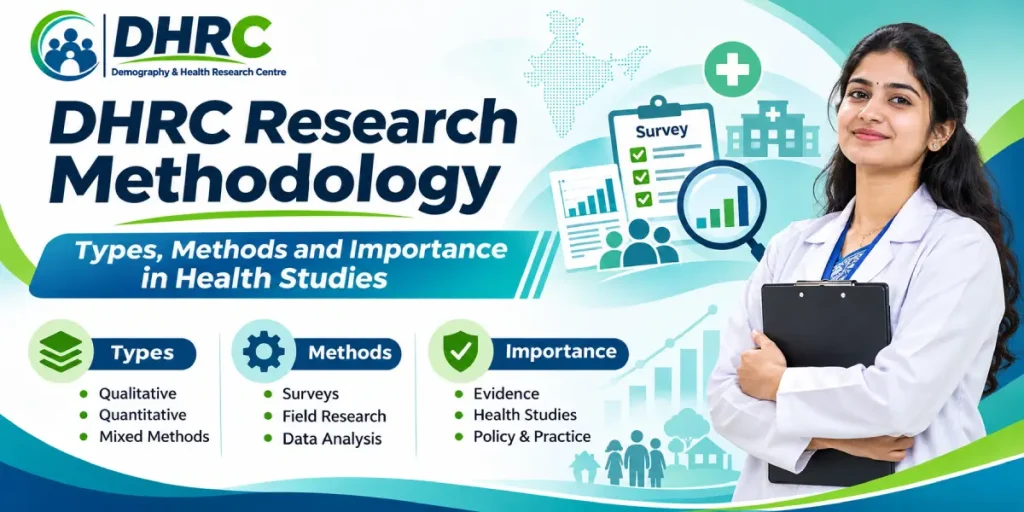
Research plays an important role in understanding health conditions, population changes, and healthcare challenges. A well-planned research methodology helps researchers collect reliable information, analyse health-related problems, and develop practical solutions. DHRC Research Methodology is particularly relevant to students, healthcare professionals, and researchers interested in population studies, public health, and social development.
The Demography and Health Research Centre (DHRC) focuses on scientific research in population and health. Its work connects demography, statistics, epidemiology, psychology, and social sciences to support better quality of life. Understanding DHRC Research Methodology helps readers explore how different research approaches can contribute to evidence-based healthcare decisions and community development.
What Is DHRC Research Methodology?
DHRC Research Methodology refers to the research approaches, techniques, and analytical procedures relevant to studying population, health, and social development. It involves identifying research questions, selecting suitable methods, collecting information, analysing findings, and presenting meaningful conclusions.
The Demography and Health Research Centre promotes scientific research in population and health-related fields. Its objectives include conducting surveys, supporting government agencies, identifying public health challenges, and providing learning resources for postgraduate students and research scholars.
A structured DHRC Research Methodology approach can help researchers understand health-related issues through reliable data and scientific investigation. It also supports the development of research-based recommendations for healthcare professionals and policymakers.
DHRC Full Form and Its Research Focus
The DHRC full form is Demography and Health Research Centre. It is a research-oriented organisation registered in Thiruvananthapuram, Kerala, India.
The centre aims to promote research in population and health and translate research findings into social development. Its research interests include maternal and child health, women’s empowerment, ageing populations, public health, and demographic challenges.
Its major areas of interest include:
- Population and demographic research.
- Public health and epidemiological studies.
- Biostatistics and statistical analysis.
- Reproductive and child health.
- Women’s social and economic development.
- Geriatric health and ageing populations.
- Research training and academic development.
These areas demonstrate how DHRC Research Methodology can connect scientific research with real-world healthcare and population challenges.
Types of Research Methodology Used in Health Studies
Different DHRC Research Methodology questions require different research approaches. Researchers must select a suitable methodology depending on their objectives, available resources, study population, and type of information required.
The following research types are commonly relevant to population and health studies.
1. Quantitative Research Methodology
Quantitative research focuses on numerical information that can be measured, compared, and analysed using statistical techniques.
Researchers use this method to understand health patterns, disease prevalence, population growth, and healthcare service utilisation.
For example, a researcher may conduct a survey involving 1,000 households to understand access to healthcare facilities in rural areas.
Common quantitative research techniques include:
- Structured questionnaires.
- Population surveys.
- Statistical measurements.
- Health indicator analysis.
- Regression analysis.
- Descriptive statistics.
Quantitative research is useful when researchers need measurable evidence to identify patterns and compare findings across different population groups.
2. Qualitative Research Methodology
Qualitative research focuses on people’s experiences, opinions, attitudes, and behaviours. Instead of concentrating mainly on numerical information, it explores why people experience particular health and social challenges.
For example, researchers may interview mothers to understand the difficulties they face when accessing maternal healthcare services.
Common qualitative research methods include:
- In-depth interviews.
- Focus group discussions.
- Direct observation.
- Case studies.
- Open-ended questionnaires.
- Community discussions.
This approach helps researchers understand social and cultural factors that influence healthcare decisions.
Qualitative methods are also useful for exploring sensitive topics, identifying community needs, and understanding patient experiences.
3. Mixed-Methods Research
Mixed-methods research combines quantitative and qualitative approaches within a single study. It allows researchers to examine both numerical patterns and personal experiences.
For example, a healthcare researcher may conduct a survey to measure vaccination coverage and interview parents to understand why some children miss vaccination appointments.
The quantitative part provides measurable information, while the qualitative part explains the reasons behind the results.
Major benefits include:
- More comprehensive research findings.
- Better understanding of community challenges.
- Stronger interpretation of collected information.
- Identification of different factors affecting health.
- Improved research recommendations.
Mixed-methods research can be particularly useful when studying complex public health and population-related issues.
4. Descriptive Research
Descriptive research explains the characteristics of a particular population, health condition, or social situation.
It helps researchers understand what is happening within a specific community without necessarily investigating the causes.
For example, a study may describe the percentage of children receiving healthcare services in different districts.
Common descriptive research activities include:
- Population profiling.
- Health surveys.
- Demographic comparisons.
- Disease distribution studies.
- Healthcare accessibility assessments.
This research approach provides a foundation for identifying areas that require further investigation.
5. Analytical Research
Analytical research examines existing information to identify relationships, patterns, and possible explanations.
Researchers may use health statistics, survey results, demographic records, and previously published studies.
For example, researchers can analyse the relationship between educational levels and maternal healthcare utilisation.
Statistical techniques such as correlation, regression, and comparative analysis may help identify important relationships.
However, an observed relationship does not automatically establish a cause-and-effect connection.
Important Research Methods Used in DHRC-Related Health Studies
Selecting the correct research method is an important part of developing a reliable study. Different methods help researchers collect information from individuals, households, healthcare facilities, and communities.
The following methods are especially relevant to DHRC Research Methodology and population-based health research.
1. Survey Research
Survey research involves collecting information from selected individuals or households through structured questions.
It is commonly used in population studies, healthcare assessments, and social research.
Researchers may ask questions about:
- Family size and household conditions.
- Access to medical facilities.
- Maternal and child healthcare.
- Health awareness.
- Educational background.
- Employment and income conditions.
Survey findings can help researchers understand community needs and identify differences between population groups.
2. Sampling Methods
Sampling means selecting a smaller group of people from a larger population for research.
Studying every individual is not always practical because of time, cost, and resource limitations. A suitable sampling strategy helps researchers collect information efficiently.
Common sampling methods include:
Random Sampling: Every eligible individual has a known chance of being selected.
Stratified Sampling: The population is divided into different groups, and samples are selected from each group.
Cluster Sampling: Researchers select groups or clusters, such as villages or schools, for investigation.
Systematic Sampling: Participants are selected using a predetermined interval from an organised list.
Convenience Sampling: Participants are selected based on their availability and accessibility.
The selection of a sampling method depends on the research objectives and population characteristics.
3. Interview Method
Interviews allow researchers to collect detailed information directly from participants.
They are useful for understanding personal experiences, healthcare challenges, and social conditions.
Researchers may conduct structured, semi-structured, or unstructured interviews depending on the study requirements.
For example, interviews with healthcare workers can help identify challenges related to medical facilities, patient services, and community health programmes.
4. Observation Method
Observation involves studying people’s behaviour, activities, or surroundings in a particular setting.
It can help researchers understand real-life conditions that may not be fully explained through questionnaires.
For example, researchers may observe healthcare facilities to understand patient waiting times, available resources, and service delivery procedures.
Observation can be conducted through structured or unstructured techniques.
5. Case Study Method
A case study examines a particular individual, family, institution, community, or health-related situation in detail.
It provides a deeper understanding of specific challenges and their surrounding circumstances.
For instance, researchers may study a rural community to understand the factors affecting access to maternal healthcare.
Case studies are useful for exploring complex situations and developing ideas for further research.
Role of Statistics in DHRC Research Methodology
Statistics is an essential part of scientific health research. It helps researchers organise information, identify patterns, compare results, and interpret collected data.
DHRC Research Methodology has an important connection with biostatistics and demographic analysis because population and healthcare studies often involve large amounts of information.
Descriptive Statistics
Descriptive statistics summarise collected information in an understandable format.
Common techniques include:
- Mean and median.
- Mode.
- Percentages.
- Frequency distributions.
- Tables and graphs.
- Measures of dispersion.
For example, researchers may calculate the average age of participants or the percentage of households with access to clean drinking water.
Inferential Statistics
Inferential statistics help researchers draw conclusions about a larger population using information collected from a sample.
Common techniques include:
- Hypothesis testing.
- Chi-square tests.
- Correlation analysis.
- Regression analysis.
- Confidence intervals.
- Statistical significance testing.
These techniques help researchers examine relationships between variables and assess whether observed differences may be statistically meaningful.
Statistical Software Used in Research
Researchers often use specialised software to organise and analyse research data.
Some commonly used tools include:
SPSS: Used for statistical analysis, data management, and research reporting.
R Programming: Useful for statistical computing, visualisation, and advanced data analysis.
Microsoft Excel: Helps organise datasets, perform calculations, and prepare basic charts.
Jamovi: Provides an accessible interface for statistical analysis and research activities.
The DHRC website has also documented training programmes covering SPSS, descriptive statistics, sampling, regression, and multivariate analysis. These subjects demonstrate the importance of statistical skills in research education.
Importance of DHRC Research Methodology in Public Health Research
Public health research helps identify health challenges affecting individuals and communities. It provides evidence that can support healthcare planning, disease prevention, and better resource allocation.
DHRC Research Methodology is relevant to this field because systematic research helps researchers understand health conditions and the social factors influencing them.
1. Identifying Community Health Problems
Research helps identify common health challenges within different population groups.
Researchers can examine disease patterns, healthcare accessibility, nutrition, and environmental conditions.
This information helps communities and policymakers understand which issues require attention.
2. Improving Maternal and Child Healthcare
Maternal and child health is an important area of population and public health research.
Researchers can study pregnancy-related healthcare, child nutrition, vaccination coverage, and access to medical services.
Research findings may help identify gaps in healthcare delivery and suggest areas for improvement.
3. Supporting Women’s Health and Development
Women’s health research examines physical health, social conditions, education, employment, and economic empowerment.
These factors can influence access to healthcare and overall quality of life.
Research can help identify barriers faced by women and provide evidence for more effective community programmes.
4. Understanding Ageing and Geriatric Health
An ageing population creates different healthcare and social support requirements.
Researchers can investigate chronic diseases, elderly care facilities, mental well-being, and access to medical services.
Such studies can support better planning for geriatric healthcare and ageing-related interventions.
5. Supporting Government Healthcare Policies
Research findings can help government agencies understand population needs and evaluate healthcare programmes.
For example, survey results may highlight differences in healthcare accessibility between rural and urban communities.
Policymakers can use reliable evidence to identify priorities, monitor progress, and plan suitable interventions.
Research Process: How DHRC Research Methodology Works
A successful research project follows a systematic process. Each stage contributes to the accuracy, reliability, and usefulness of the final findings.
Here are the major steps involved in health-related research.
Step 1: Identify the Research Problem
The first step is selecting a specific problem that requires investigation.
Researchers should clearly define what they want to study and why the topic is important.
For example, a study may investigate limited access to maternal healthcare in rural communities.
Step 2: Review Existing Literature
Researchers examine previously published studies, reports, academic papers, and relevant research documents.
A literature review helps identify existing knowledge and research gaps.
It also helps researchers develop suitable questions and objectives.
Step 3: Define Research Objectives
Research objectives explain what the study aims to achieve.
They should be clear, specific, and measurable wherever possible.
For example, the objectives may include measuring healthcare accessibility, identifying common barriers, and comparing service availability across different locations.
Step 4: Select the Research Design
The research design provides a framework for conducting the study.
Researchers select an appropriate design based on their objectives and available resources.
Common research designs include:
- Cross-sectional studies.
- Longitudinal studies.
- Cohort studies.
- Case-control studies.
- Experimental studies.
- Observational studies.
Step 5: Collect Research Data
DHRC Research Methodology collect information through surveys, interviews, observations, medical records, or other appropriate sources.
The selected data collection method should match the research question.
Participants must receive appropriate information about the study, and their privacy should be protected.
Step 6: Analyse the Collected Information
After collecting information, researchers organise and examine the data.
Quantitative information may be analysed using statistical software, while qualitative information may be examined through coding and thematic analysis.
The objective is to identify meaningful patterns and answer the research questions.
Step 7: Interpret and Present Findings
Researchers explain what the results mean and how they relate to the original research objectives.
Findings may be presented through reports, academic papers, tables, graphs, and presentations.
Researchers should also discuss study limitations and avoid making conclusions that are not supported by the evidence.
Ethical Considerations in DHRC Research Methodology
Research involving human participants requires careful attention to ethical principles.
Healthcare and population studies may involve personal information, medical details, family conditions, and sensitive social experiences.
Therefore, researchers should follow appropriate ethical standards throughout the research process.
Important ethical considerations include:
Informed Consent: Participants should understand the purpose, procedures, and possible risks of a study before agreeing to participate.
Privacy Protection: Personal information should be handled securely and accessed only by authorised individuals.
Confidentiality: Researchers should avoid disclosing participants’ identities without proper permission.
Voluntary Participation: Individuals should be free to participate or withdraw according to the study’s approved procedures.
Ethical Approval: Research involving human participants should receive approval from the appropriate ethics committee whenever required.
Accurate Reporting: Researchers must present findings honestly without manipulating data or hiding important limitations.
Following these principles helps maintain trust and protects the rights and well-being of research participants.
DHRC Research Methodology and Population Studies
Population studies examine the size, structure, distribution, and changes of human populations.
They help researchers understand important demographic factors such as birth rates, death rates, migration, age distribution, and family structures.
DHRC Research Methodology is closely connected with population studies because demographic information can help explain differences in health conditions across communities.
For example, researchers may study how population ageing influences healthcare requirements or how migration affects access to medical facilities.
Important areas of population research include:
- Population growth and distribution.
- Fertility and mortality patterns.
- Migration and urbanisation.
- Family and household structures.
- Maternal and child health.
- Ageing and elderly populations.
- Population health inequalities.
The findings can support social development planning and improve understanding of the relationship between population changes and healthcare requirements.
Difference Between DHRC, DHRC Hospital and DHRC Courses
People searching online for DHRC-related information may encounter different terms. Understanding their meaning can help avoid confusion.
What Is DHRC?
DHRC stands for Demography and Health Research Centre. The organisation focuses on scientific research, population studies, health-related activities, and research training.
Is DHRC a Hospital?
The Demography and Health Research Centre should not be confused with a hospital.
Its published objectives focus on research, surveys, education, and population and health studies. It also lists certain support and intervention services, but its identity as a research centre does not establish it as a general hospital.
Individuals looking for medical treatment should verify the services and qualifications of an appropriate healthcare provider.
What Are DHRC Courses?
People searching for a DHRC course may be interested in research training, statistical analysis, demography, epidemiology, or public health.
The centre’s website has listed training activities and workshops related to research methodology and statistical skills.
Some documented training subjects include:
- Research methodology.
- Basic statistics.
- Descriptive statistics.
- Sampling techniques.
- Sample size determination.
- SPSS and statistical analysis.
- Regression analysis.
- Qualitative research.
- Multivariate analysis.
Course availability, eligibility, duration, and fees may change. Interested students should check the official DHRC website for current programme details.
Challenges in Health Research Methodology
Although research provides valuable information, conducting a reliable study can involve several challenges.
Understanding these limitations helps researchers plan better studies and interpret findings carefully.
1. Limited Research Resources
Some research projects require financial support, trained staff, specialised equipment, and sufficient time.
Limited resources can affect the size and scope of a study.
2. Data Collection Difficulties
Collecting accurate information from large or geographically distant populations can be challenging.
Language barriers, incomplete responses, and participant availability may affect data quality.
3. Sampling Errors
An inappropriate sampling method may produce results that do not accurately represent the target population.
Researchers should carefully determine sample size and selection procedures.
4. Data Quality Issues
Incorrect entries, missing responses, and inconsistent measurements can affect research findings.
Proper data management and quality checks are important for reducing these problems.
5. Ethical and Privacy Concerns
Health research often involves confidential information.
Researchers must follow appropriate ethical requirements and protect participant information throughout the study.
Future Scope of DHRC Research Methodology
DHRC Research Methodology Health research continues to develop with improvements in technology, statistical software, and data collection techniques.
These developments create new opportunities for researchers working in population studies and public health.
Some important future research areas include:
Digital Health Research: Digital healthcare systems can provide information about service utilisation, patient experiences, and healthcare accessibility.
Advanced Statistical Analysis: Modern statistical techniques can help researchers examine complex relationships within population and health datasets.
Community-Based Research: Local studies can help identify specific healthcare challenges and develop practical interventions.
Ageing Population Research: Increasing attention to elderly care can support research into chronic diseases, long-term care, and quality of life.
Maternal and Child Health: Further research can improve understanding of nutrition, reproductive health, and healthcare accessibility.
Evidence-Based Policymaking: Reliable research findings can support the development and evaluation of public health programmes.
These areas demonstrate why DHRC Research Methodology and related research skills remain relevant to students, healthcare professionals, and academic researchers.
Conclusion
DHRC Research Methodology provides a scientific foundation for understanding health conditions, population changes, and social development challenges. From quantitative and qualitative research to surveys, sampling, interviews, and statistical analysis, each method contributes valuable information to health studies.
DHRC Research Methodology highlights the importance of systematic investigation, reliable data collection, ethical research practices, and evidence-based conclusions. The Demography and Health Research Centre brings together different academic disciplines to promote scientific research in population and health.
For students, researchers, and healthcare professionals, understanding these methods can improve research skills and support better interpretation of health-related information. Ultimately, well-conducted research can contribute to informed healthcare decisions, effective public health planning, and improved community well-being.
Frequently Asked Questions (FAQs)
1. What is DHRC Research Methodology?
DHRC Research Methodology refers to research approaches and techniques used to investigate population, health, and social development topics. It includes research design, data collection, sampling, statistical analysis, and interpretation.
2. What is the full form of DHRC?
DHRC stands for Demography and Health Research Centre. It is an organisation focused on scientific research in population and health.
3. What types of research methods are used in health studies?
Common methods include quantitative research, qualitative research, mixed-methods research, surveys, interviews, observation, case studies, and statistical analysis.
4. Is DHRC a hospital or a research centre?
DHRC stands for Demography and Health Research Centre. It is a research-oriented organisation that focuses on population studies, public health, scientific research, and educational activities rather than functioning as a general hospital.
5. What can students learn through DHRC research courses?
Depending on the available programmes, students may learn research methodology, demography, biostatistics, sampling techniques, SPSS, statistical analysis, epidemiology, and qualitative research.